7 Minimalist Home Office Ideas for a Clean, Organized Workspace
A minimalist home office isn't about owning less for its own sake. It's about keeping the few things that help you focus and letting go of the rest. These seven ideas lean on neutral color, simple storage, and a layout that works with your room so the space feels calm and does its job. Each one is a decision you can make this week without redecorating from scratch.
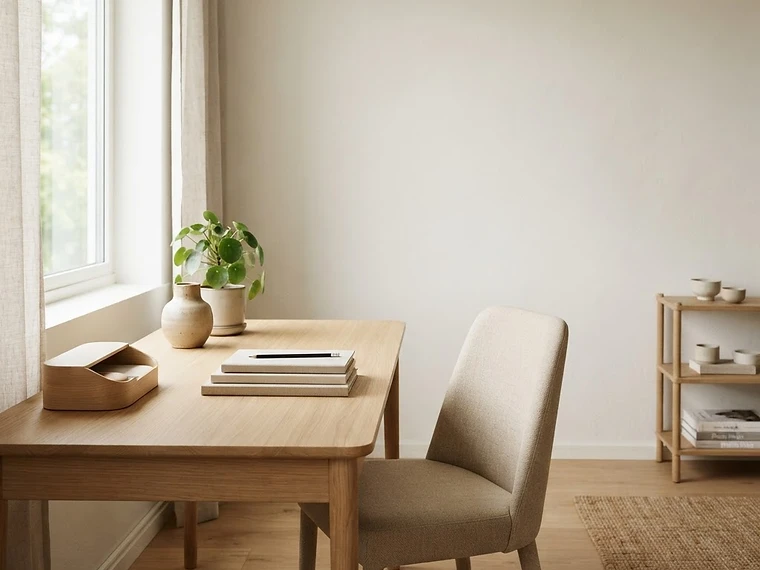
1. Start by decluttering, not by buying
Before any new furniture, clear everything off the desk. A blank slate is the fastest way to see what you actually use during a workday versus what has simply accumulated. Remove the lot, then put back only the items you reached for in the last week. Store the rest, donate it, or recycle it. If you can't remember the last time you used a cable, a charger, or a gadget, that's your answer.
This is also where you consolidate, not just discard. Four single-purpose devices take up more surface than one device that does all four jobs; an all-in-one that prints, scans, copies, and faxes from a single footprint replaces a separate printer, scanner, and copier and keeps the desk clear for actual work. The same logic applies to power: a single wall outlet extender with built-in AC and USB ports replaces a tangle of adapters and a loose power strip, so one cable run does the job of five. Fewer objects, fewer cords, one clear surface.
2. Choose a desk with built-in storage
In a minimalist home office the desk does most of the work, so let it earn its footprint. A surface with a drawer or two underneath gives every daily object, pens, notebooks, chargers, a home of its own, so the top stays clear by default. That is the whole point of home office organization: give each item a place so it never lives on the surface. Browse the home office collection for desks and storage that build that in.
If the room is small, a compact desk in a light, neutral finish keeps the footprint honest without feeling like a compromise. A white or light-wood desk recedes visually, which is exactly why it reads as calm in a tight room. Measure before you buy: you want at least 24 inches of clear depth for a laptop and a place to rest your forearms, and enough clearance underneath for your legs without bumping a drawer.
3. Let natural light lead the layout
Place the desk perpendicular to a window where you can, rather than flat against a wall. Side light reduces screen glare and makes a small room feel larger than its square footage. If a window desk isn't possible, position a lamp so the light comes from the non-writing side and add a soft, neutral shade to keep the tone warm rather than clinical.
Keep window treatments simple. A plain linen or cotton panel in an off-white tones with most minimalist palettes and won't fight the rest of the room. Pull curtains wide during the day so the glass reads as part of the wall, not as a blocked-off corner. The goal is a room you can sit in for hours without the light fighting you.
4. Build the palette around neutral colors
A restrained palette is what makes a minimalist office feel intentional rather than empty. Pick two or three neutrals and stop: a warm white or parchment for the walls and the biggest surfaces, a soft wood or stone tone for the desk, and one quiet accent for textiles. Then repeat those exact tones across the rug, the chair, and any storage so the room reads as one composition instead of a collection of objects.
This is also the move that ages best. Neutral colors are easy to refresh later with a single new object, where a bold scheme commits you to matching everything to it for years. If you're unsure, lean warmer; a parchment or sand undertone feels lived-in where pure white reads as a showroom.
5. Use vertical space for planning and organization
When surface space is limited, use the wall. A large magnetic glass board gives you a single place to keep the week's plan, notes, and reminders visible without adding any furniture to the floor, and a tempered glass surface stays clean where a standard board would ghost and stain over time. Because it's magnetic, the same surface holds a printed plan and a few notes with magnets, so it does two jobs at once. Mount it at eye level where you'll actually see it, not behind the door.
The same vertical thinking applies to shelving: one open shelf above the desk, kept mostly empty with a few considered objects, reads as more restful than a full bookcase. The wall is free real estate in a small room, so use it for what you need to see, and keep the floor clear.
6. Plan the layout for comfort, then for looks
A workspace that looks beautiful but hurts after an hour isn't organized, it's staged. Start with ergonomics: screen at eye level, feet flat on the floor, elbows near 90 degrees, and enough room under the desk for your legs. A sit-stand desk lets you change posture through the day without adding a second piece of furniture, which keeps the room minimal while supporting how you actually work, and the home office picks that support the work follow the same logic. Set your standing height first and your sitting height second, since most people stand less than they think.
Only once the layout is comfortable should you layer in the decorative choices. Comfort first, styling second, and the two rarely conflict when the palette is restrained. If a chair looks right but leaves you shifting after 20 minutes, it's the wrong chair, full stop.
7. Keep decorative accents simple and few
The final layer is the one most people overdo. In a minimalist home office a single accent is enough: one plant, one ceramic object, or one framed print. The goal is for the room to feel like a workspace with a touch of personality, not a styled showroom. Pick the object you actually want to look at during a slow afternoon, not the one that photographs best.
If you add a second object, let it earn its place by doing something. A small tray that corrals keys and a pen, a cup that holds brushes, a board that holds the week's plan. Beautiful and useful is the minimalist ideal; useful alone is fine; beautiful alone is where clutter starts. When in doubt, leave it out for a week and see if you miss it.
Images are for styling inspiration. Featured products may differ from those pictured.
Shop the Look
Real products from our curated collection to help you recreate this look at home.

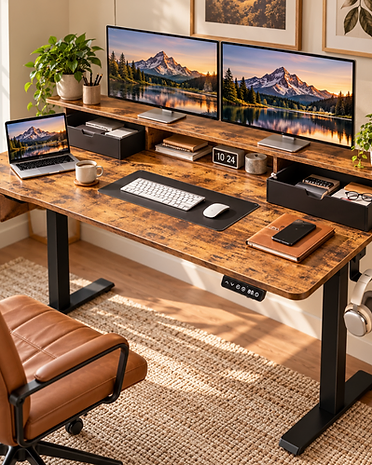
Veken 47"x28" Electric Standing Desk with Drawers, Adjustable Computer Desk (Brown)
Best for A sit-stand electric desk with storage and memory presets for home office work
A 47"x28" electric standing desk with a brown wood-grain top, integrated drawers, storage hutch, 3 memory presets, a cable organizer, a headphone hook, and a quiet lift motor.


BHG 39.3" White Desk with Drawers, Small Computer Desk for Home Office
Best for A compact desk with storage that fits small home-office or bedroom spaces
A 39.3-inch white computer desk with an open storage cubby and two drawers, sized for small home office, study, or vanity use in bedrooms and living rooms.


One Beat Surge Protector Outlet Extender with Rotating Plug
Best for Power and cable management
Wall outlet extender with 6 AC outlets and 4 USB ports (2 USB-C), a 1800J surge protector, and a rotating plug — a plug-in power strip for home office, dorm, and travel.


Quartet Magnetic Dry Erase Board, 72"x48" Glass Whiteboard, Infinity (Black, G7248B)
Best for A large wall-mounted glass whiteboard for home office or workspace planning
A 72"x48" magnetic glass dry-erase board with a tempered black glass surface, silver stand-off mounts, and a marker tray for wall-mounted use in home offices or workspaces.

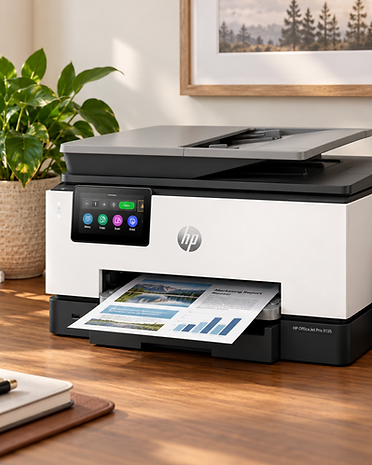
HP OfficeJet Pro 9135 Wireless All-in-One Color Inkjet Printer
Best for An all-in-one color inkjet printer that prints, scans, copies, and faxes from one footprint with duplex and an auto document feeder
HP OfficeJet Pro 9135 wireless all-in-one color inkjet printer — print, scan, copy, and fax with ADF, duplex print/scan, best-for-office, 3-month Instant Ink trial, and AI-capable features (C2WM0A).
Browse the Collection
Explore thoughtfully chosen home products, curated for every room.
Explore Our Collection
